Long Beach State University Athletics
1/26/2026 12:20:00 PM | Men's Volleyball
Long Beach State unveils its 2025 national championship banner, honoring a title, a legacy, and a culture built to last.
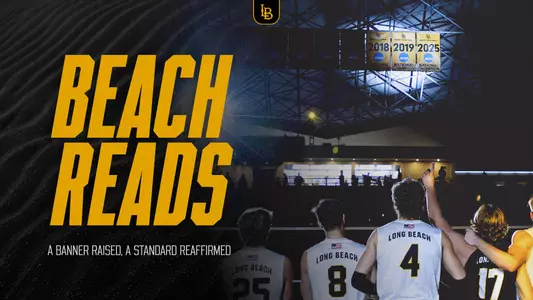
LONG BEACH, Calif. - On Saturday night, the lights inside LBS Financial Credit Union Pyramid hit a little differently.
Before the first serve against Long Island on January 24, 2026, Long Beach State pulled the curtain back on its newest marker of excellence, a national championship banner that now lives alongside the program's most iconic eras. The night doubled as a homecoming, too, welcoming back championship alumni and former head coach Alan Knipe as the Beach honored the 2025 title team that claimed the program's fourth NCAA crown.

It was a scene built for reflection. Not only on the championship itself, but on the culture that made it feel inevitable even in a season that was anything but smooth.
Because if 2025 proved anything about Long Beach State men's volleyball, it was that the program's competitive advantage has never been a single recruit, a single system, or even a single season. It has been sustainability. A standard that survived coaching changes, conference realignment, and the modern churn of college athletics. A standard that, for the better part of a quarter-century, bore the unmistakable imprint of Alan Knipe.
Knipe's story at Long Beach State has always been bigger than a career arc. It is an origin story, a blueprint, and a philosophy.
He did not enter volleyball through the front door. He found it through a workaround.
Back when I was playing, there wasn't a whole lot of opportunities to get involved in the sport, Knipe said. The entry point in his freshman year of high school, he recalls, was almost accidental: a football coach's proposition that if players tried out for volleyball, you could take the week off from spring conditioning.
He was tall, athletic, inexperienced, and curious. He tried out, got hooked, and never really let the sport go.
From there came a year at Orange Coast College, and a pivotal connection. Mike D'Alessandro, then an assistant coach at Long Beach State and the coach at OCC, recruited him hard. Knipe remembers being pulled in not by a pitch about trophies, but by vision. By the feel of the gym, the people, the absence of ego, and the sense that the group wanted something it had not yet fully touched.
When I got a chance to be around the guys on a recruiting trip, I realized Long Beach really is who I am and the place I want to be, Knipe said. There was this culture about this group that I kind of just fell in love with immediately, about how much everyone cared about each other, and it didn't seem like there was a lot of egos, and it seemed like they really wanted to be great.
He grew up nearby in Huntington Beach, the son of a Northern Irish father with a blue-collar, old-school coaching mentality. The message at home was simple: work for everything, expect nothing to be given. Long Beach State felt aligned with that upbringing. A place where people cared about each other, where the aspiration to be great was not performative, and where success could be built rather than inherited.
That sense of alignment became a commitment. When Knipe first began coaching at Long Beach State, he was already thinking in decades. In part because the campus culture normalized it, with coaches who stayed 20, 25, even 30 years, and in part because it was his alma mater. He did not just want to win. He wanted to replicate what the 1990 to 1992 era felt like, and make it sustainable.
That word, sustainable, is the through-line of his legacy, and the easiest way to explain why Long Beach State has remained a destination program.
Knipe retired as the only person to have been part of all four national championships in program history, winning as a player in 1991 and later as head coach in 2018, 2019, and 2025. That is the headline. The deeper story is the infrastructure behind it.
Knipe often talks about culture not as a slogan but as a skill. In his view, culture starts with communication, and communication is difficult in modern life. A healthy culture, he argues, is not one without conflict. It is one capable of tough conversations that do not fracture trust.
If you think about trust, you think of trust as basically like a piggy bank, Knipe said. You're either putting coins in it or you're taking coins out of it.
His goal at Long Beach State was to flood the account, to build so much trust that when disruption arrived, the program could spend it and still survive.
He points to the COVID era as proof. Long Beach State was late to return to practice. The roster that had reached the mountaintop in 2019 scattered. Momentum stalled. The team leaned on Zoom calls and relationship equity, and by 2022, Long Beach State was back in the national championship match. In Knipe's mind, that rebound was not a coincidence. It was culture doing what culture is supposed to do when things turn.
That cultural foundation also allowed the program to navigate a reality that mid-major programs know well: transition. People come and go. Roles shift. Resources can be inconsistent. Knipe's approach, by his own description, was to take ownership, refusing to let the uncertainty of change become a program identity.
All of that set the stage for what became the modern golden era, the reboot that began when Knipe returned from leading the U.S. Men's National Team. From 2013 onward, Long Beach State stacked recruiting classes, rebuilt the machine, and ultimately assembled the group that delivered four straight Final Fours and two national championships.
Knipe's recounting of that era is honest about the parts that hurt. The 2016 and 2017 teams reached the Final Four and lost in the semifinals. In the eyes of outsiders, it looked like falling short. In his eyes, it was the education championship teams require.
Then came 2018, a title run that ended with a championship match against UCLA on UCLA's floor. It was a five-set knife fight that could have broken either way. Long Beach State won it anyway, then returned in 2019 with a target on its back and a national championship match hosted at home, a rare gift in college sports.
That 2019 title, won at the Pyramid, remains one of the most meaningful moments of Knipe's career because it included everyone. Season ticket holders, donors, long-time supporters, and the entire volleyball community that may not have traveled to a neutral site got to witness the program's peak in person.
When the 2025 season arrived, it did not arrive with the comfort of continuity. Long Beach State had played for the national championship in 2024 at home and lost, then had to replace significant pieces. What it did have was talent, and one incoming freshman who quickly began to stretch the boundaries of what was normal in men's volleyball.
Moni Nikolov did not merely fit into Long Beach State's system. He forced opponents to adjust before rallies ever began.
Fast forward to May 2025, Nikolov had been named AVCA National Collegiate Player of the Year, becoming just the second player, alongside his older brother, Alex Nikolov, in AVCA history to earn both National Player of the Year and Newcomer of the Year honors in the same season. His arrival did not change Long Beach State's identity, but it amplified it. His tempo sharpened the offense. His presence allowed the Beach to absorb injury, rotation changes, and pressure without losing its edge.
We knew he was going to have a massive impact on our team, and also maybe college volleyball, Knipe said.
Long Beach State's 2025 championship match showed it at full volume.
In Columbus, Ohio, top-seeded Long Beach State swept No. 3 UCLA to secure the program's fourth national title. Nikolov was named NCAA All-Tournament MVP as the Beach finished 30-3 and joined rare company in program history.
That sweep carried symbolic weight. Not because championships require dominance to count, but because 2025 was not a season built for comfort.
Knipe describes the team with one word that keeps resurfacing: resilient.
Long Beach State lost three starters over the course of the year. Then, near the end of the regular season, the Beach lost its starting opposite, Daniil Hershtynovich, for the season. In most years, that is the moment where the margin disappears.
Instead, Long Beach State treated it like another problem to solve.
By the time the Beach arrived in Columbus, the season's message was already clear. Whatever obstacle appeared next, this group had proven it would adjust without losing itself.
They proved it again and finished the job.
When the match ended, so did a chapter Knipe did not yet know he was closing.

Which brings it back to January 24, inside LBS Financial Credit Union Pyramid, as the 2025 National Championship banner was unveiled.
The ceremony did not feel like a conclusion. It felt like a confirmation. The banner is proof of what the program achieved in 2025, proof of what the program has been built to sustain.
Now, when the Beach runs out onto the floor beneath it, the banner does not simply mark a title. It marks a standard.
The banner honors 2025. The standard extends far beyond it.