Long Beach State University Athletics
Haneef Fights Through Heart Ailment
8/25/2008 12:00:00 AM | General
Aug. 25, 2008
BEIJING - She never knows when it's coming.
Tayyiba Haneef-Park only knows that it will.
Maybe next week. Maybe in an hour.
Maybe in Saturday's Olympic women's volleyball final with Brazil, Haneef-Park's heart will take off racing at an unnatural pace, leaving her gasping, dizzy, her body hanging on for dear life.
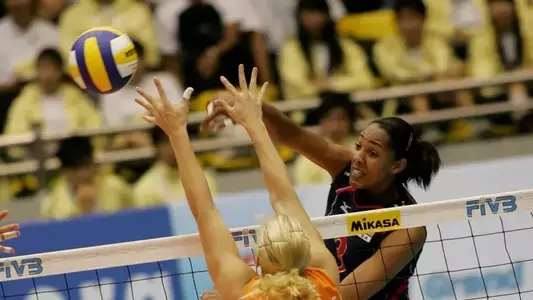
It happened during the U.S. first round match with China August 15. Haneef-Park fought through it to help Team USA upset the defending Olympic champions, the first in string of surprises that have landed the U.S. in its first Olympic final in 24 years.
And it happened in a match in Russia two years ago. That time Haneef-Park wondered if she would live through it.
Haneef-Park, the 6-foot-7 outside hitter from Laguna Hills, suffers from supraventricular tachycardia (SVT), an abnormal heartbeat in the upper chambers of the heart created by abnormal electrical connections that cause the heart to beat too fast.
She has struggled with the condition that was undiagnosed until recently since childhood, frustrated that it kept happening at the worst times, frustrated that doctors couldn't figure out what was wrong with her, wondering if, like those closest to her, she wouldn't just drop dead on a volleyball court like another Olympian Flo Hyman did in 1986?
"I can never tell when it's going to happen," she said. "It is really random for me. Some times it will have once a week, sometimes once every few months. There was never a pattern that I was able to pick up on to tell me when to expect it."
Through it all Haneef-Park, 29, emerged as one of the best volleyball players on the planet, leading the U.S. to the 2004 Olympic Games, a pair of bronze medals in the 2007 World Cup and Pan American Games and then back to a second Olympics.
Then in June, just weeks before Beijing Games, doctors were finally able to diagnose the SVT and Haneef-Park underwent a heart procedure to correct it.
"Unfortunately," she said, "I am still having symptoms."
Which makes her already impressive play in Beijing even more stunning.
Haneef-Park ranks fourth in scoring, fifth in kills at the 2008 Games. She had a match high 12 points in the semifinal upset of four-time Olympic champion Cuba that ensured the U.S. women of their first medal since 1992.
"Tayyiba has played great," U.S. coach Jenny Lang Ping said. "Just unbelievable."
Haneef-Park was likely born with SVT, she said.
"I can't remember when it started but its pretty much something I have had all my life," she said. "I remember days when I was twirling the baton when I was about 6 and having the same episodes."
She moved on from the baton to volleyball and track and field, emerging as an athlete with world class potential in both at Long Beach State.
She placed 10th in the high jump at the 2000 Olympic Trials then led the 49ers to a 33-1 record and the NCAA title match in 2001.
Haneef-Park had an almost instant impact after joining the U.S. national team in 2001, averaging 10.2 points per match in helping Team USA to the silver medal at the 2002 World Championships.
All the while, Haneef-Park continued to have heart problems. Sometimes the episodes of palpitations, dizziness, weakness in the legs, would last for a few seconds, sometimes a few minutes.
Her concerns, and those of her family, friends and coaches, were heightened by the death of Hyman. Hyman died on the sideline after being substituted out of a January 1986 match.
An autopsy later determined that Hyman died from an aortic dissection resulting from undiagnosed Marfan syndrome, a genetic disorder that usually strikes exceptionally tall people.
Ironically, Haneef-Park was also playing in Japan when she underwent tests that ruled Marfan out as the cause of her racing heart.
So if it wasn't Marfan what was it?
Repeated trips to doctors determined nothing so Haneef-Park decided to try and live with it. After the match in Russia she wondered if she would.
Haneef-Park collapsed during the match and had to be carried off the court on a stretcher. After the incident she intensified her search for an answer.
"The low point was when I went to the doctors last year and went through all the testing and wearing a heart monitor and the doctor told me that I was just out of shape and needed to run more cardio," she recalled.
"I couldn't believe it. I may not be in the best of shape at times but I knew that this was something that I have had forever and was confident that that was not the reason. I wouldn't accept that as and answer and therefore had to go through all the testing over again this year with a new doctor.
"I would tell the doctors my symptoms which usually involved a racing heart beat. I would tell them it was beating fast but they didn't know what fast was, so they hooked me up to the monitor to get a realistic scale."
Haneef-Park then stuck a monitor in her sports bra during practices in hopes of recording an episode. "Which made it difficult to do rolling or dives on the court," she said
In June, the monitor captured an episode and SVT was finally diagnosed. She underwent a procedure where a wire was inserted into a vein in her groin and threaded to her heart where it burned the electrode that causes her heart to beat too fast.
"(The doctors) told me it was not life threatening," Haneef-Park said of the procedure. "They mentioned that the only cure was surgery and that after I had had it I would be back on the court in less than a week."Sure enough less than a week later she was on a plane to the FIVB Grand Prix in Japan.
Doctors also told her she could still suffer symptoms for another month. Two months later her heart is still racing.
And now Haneef-Park is in the biggest match of her life, the biggest match the U.S. has played in nearly a quarter-century, determined to keep pace with her heart.
The other day she was asked what the difference was between the U.S. team that was fifth in Athens and the one that will play Brazil for the gold medal. The answer should have been obvious.
"We are the same players with the same skills but we have more fight behind us," she said.