|
Defining Craig Hodges
by LZ Granderson, ESPN.com
February 11, 2008
Expert (adj): having special knowledge of or skill in a subject
If you scan the stats of the Los Angeles Lakers, you will find six players
who are currently hitting 3-pointers at a clip several percentage points
higher than their career averages.
Part of this has to do with the maturation of Andrew Bynum and the sudden
need to double him on the blocks, thus freeing L.A.'s shooters.
But a lot of credit should be given to the team's resident expert, assistant
coach Craig Hodges.
Despite winning two titles and three consecutive 3-point contests with
the Bulls, Craig Hodges was out of the NBA for 13 years.
Only two players have ever won three consecutive 3-point shooting contests
during NBA All Star weekend -- Larry Bird and Hodges. A two-time regular-season
3-point champ, Hodges' chance for a fourth straight All-Star victory was
derailed when the Chicago Bulls cut him after the 1992 season and he wasn't
signed by another team. Actually, he wasn't even invited to camp for any
of the remaining 26 teams, either. Barely 32 and still peppered with confetti
from the championship parade, Hodges not only was out of the league as
a player but also was unable to find any NBA job until Phil Jackson hired
him as a shooting coach in 2005.
"I went from making $600,000 a year to making nothing," Hodges
said. "No one would take my calls, no one would give me a chance.
I went from helping a team win it all, to all of a sudden not being good
enough to play for the worst team in the league.
"Do I think the league had it out for me? You tell me."
Blackball (v): to exclude from membership by casting a negative vote
Hodges' story goes a little like this: He buddied up with the Nation of
Islam's Louis Farrakhan, challenged black athletes -- including teammate
Michael Jordan -- to do more in their community, and showed up at the
White House in 1992 wearing a dashiki. While there, he handed the first
President Bush a letter urging him to address what Hodges called the injustices
inflicted on the black community.
A short time later, Hodges was cut.
"I was outspoken, but I wasn't disrespectful," he says. "I
was never in trouble for drugs, or guns or raping women or anything like
that.
I just wanted to help my community, and that made me a troublemaker.
"What I did at the White House embarrassed the league, and it made
a lot of people uncomfortable, and they did something about it."
Conspiracy (n): a secret agreement between two or more people to perform
an unlawful act
Commissioner David Stern has always denied any plot against Hodges after
the incident. In fact, he said he was there with the Bulls at the White
House that day and told Hodges he liked his attire.
Besides, at the time, Hodges was an undersized shooting guard who couldn't
stop a mannequin from getting to the rim. In his final year in the league,
he missed 26 games because of injuries and was playing less than 10 minutes
a game.
However, when he was on the court he was still hitting 37.5 percent of
his 3s. More importantly, he had an intimate knowledge of Chicago's famed
triangle offense -- the kind of knowledge that could have helped opposing
teams defend it.
"I played for Tex Winter for four years at Long Beach State,"
Hodges said. "I knew the triangle offense better than Phil Jackson.
People want to say my skills were declining. That's debatable. But you
can't say my knowledge of the game couldn't help teams win games. And
nobody could shoot like me.
"Nobody."
After failing to get a single team interested in him, an angry and desperate
Hodges sued the league and its owners in 1996 for blackballing him for
his "black militant" views.
He lost, of course.
It's difficult to prove a league that was 80 percent black at the time
was being run by a bunch of racist whites.
Still, it is curious that a player who's a career 40 percent 3-point shooter,
who just hit 45 percent of his 3s in the playoffs en route to helping
his team win a championship, and who never had a technical foul called
on him in 10 years, couldn't get at least a tryout invite from a single
NBA team. Not a Dallas squad that finished the 1992-93 season with 11
wins and three guards who shot less than 20 percent from 3? Or how about
a 25-win Sacramento roster that included 5-foot-11, 153-pound Stan Kimbrough,
who played a grand total of 65 minutes in his two-year NBA career? Hodges
wasn't good enough to compete against that?
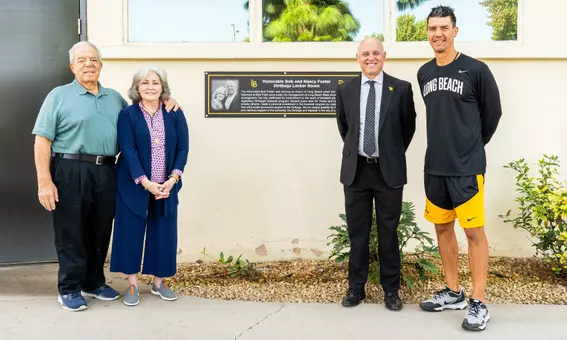
Hodges, pictured at far right, joined the Lakers coaching staff in 2005.
Supposedly Billy McKinney, who was a VP for the Pistons at the time, was
the only person to reach out to Hodges about playing after the Bulls cut
him. But that offer was quickly retracted, with McKinney being widely
reported as telling Hodges, "Brothers have families, if you know
what I mean."
McKinney, a onetime Clippers teammate of Hodges, denies making that statement.
"I never heard of a leaguewide conspiracy to keep Craig out,"
says McKinney, who is now a broadcaster with the Timberwolves. "I've
been there as a player myself. Jobs are scarce, and you are desperately
trying to hang on. It didn't make sense for me to bring him in for a tryout
because I knew there wasn't a snowball's chance in hell he'd make the
team.
"I'm not sure why the other teams didn't bring him in … you'd
have to ask them."
Irony (n): apparent perversity of an event or circumstance in reversing
human intentions.
Hodges' story is full of it.
Irony, that is.
Like how the coach who cut him from the Bulls -- and essentially out of
the league -- was the one to welcome him back.
Or how prominent members of the very community he sacrificed his career
to help were unwilling to help him get that career back.
And I'm not just talking NBA types.
"I asked Jesse Jackson to help me and he wouldn't," Hodges said.
"I asked Johnnie Cochran to represent me and he wouldn't. I don't
want to talk bad about the dead but … he represented O.J., but he
wouldn't help me.
"That's messed up."
Yeah, it is.
Which leads to the question of …
Regret (n): feeling or sorrow or repentance, etc., over an action or loss,
etc.
As in "Craig Hodges has no … "
"I was able to play 10 years in the league and I won championships,"
he said. "So no sour grapes on my part.
"But at the same time, I'm disappointed because I did what I felt
I needed to do to help my community, and it cost my grandchildren millions
of dollars. It cost my community millions of dollars because I wasn't
able to invest that money and give back."
Unsung hero (n): see Craig Hodges.
|